
Quick answer: For a U.S. buyer seeking a gas-powered, automatic step-through scooter, Honda is a strong place to start for everyday practicality; Vespa for premium retro design; Yamaha for an active, sporty commute; Genuine for approachable 50–170cc city scooters; KYMCO for equipment at a competitive price; Piaggio for Italian high-wheel urban styling; and SYM where there is a nearby dealer offering dependable service and parts. These are use-case recommendations rather than laboratory reliability rankings.
Updated October 25, 2026. This guide compares gas motor scooters sold or marketed to U.S. riders, not kick scooters, stand-up electric scooters, or mobility scooters. We checked official U.S. product and warranty pages for representative models. Prices, trims and local availability can change; check a current dealer quote before you buy.
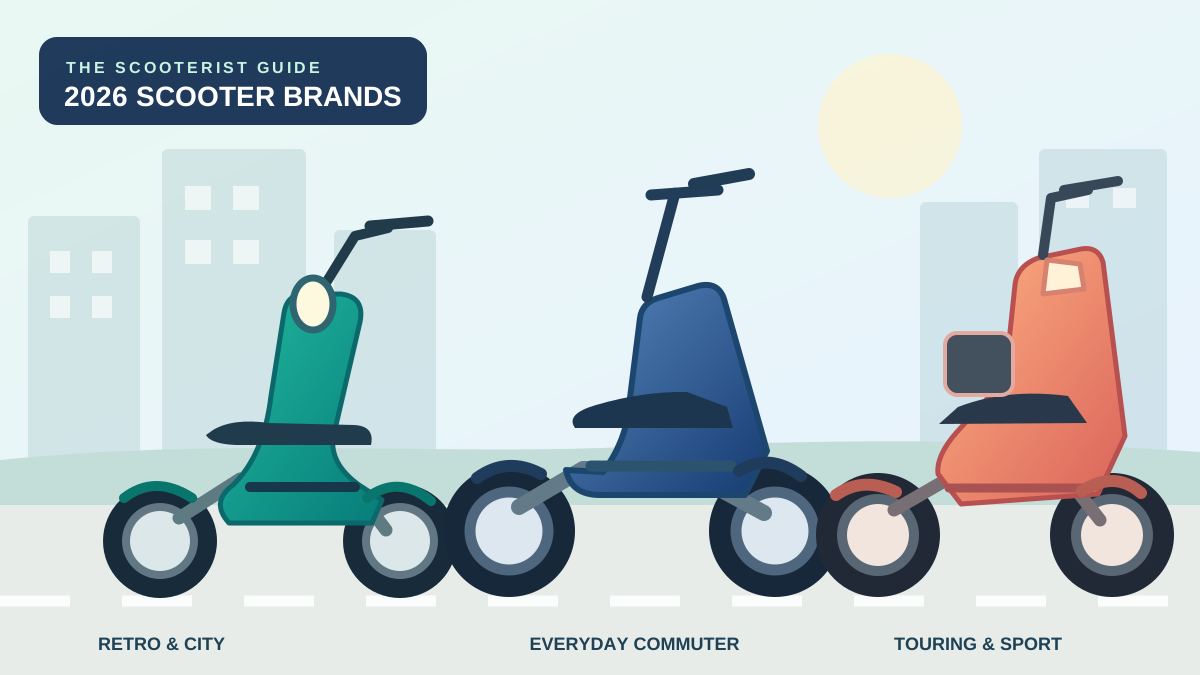
Best scooter brands at a glance
If you only have a minute, match the type of riding to a model that local dealers actually support. Displacement is an engine specification, not a promise of speed or an exemption from licensing.
| Brand | Example U.S. model | Engine | Best suited to | Before you buy |
|---|---|---|---|---|
| Honda | 2026 PCX | 157cc | Comfortable everyday commuting | Test seating position; confirm total dealer price |
| Vespa | 2026 Primavera 150 | 150cc class | Premium retro design | Price accessories and nearby specialist service |
| Yamaha | 2026 Zuma 125 | 125cc | Sporty city use | Try seat height and storage access |
| Genuine | Buddy 125 | 125cc class | Budget-aware city errands | Confirm authorized dealer and warranty terms |
| KYMCO | Like 150i ABS | 149.8cc | Feature-focused value | Check dealer service and ABS on the exact trim |
| Piaggio | Liberty 150 | 150cc class | Light urban/high-wheel feel | Verify U.S.-market model and local stock |
| SYM | Jet 14 200i | 169cc | Riders with local SYM support | Check current inventory and parts lead times |
What this table is not: a controlled road test, a statistically proven reliability league table, or a price comparison across identical engine sizes. The model figures come from brand and U.S.-distributor publications linked below.
Which scooter brand should you choose?
For the easiest decision: start with the dealer, not the badge
The right scooter is the one that fits your commute and can get routine maintenance, tires, warranty assistance and replacement parts near home. Before committing, locate a scooter dealer, ask whether its workshop services that exact model, and compare at least two out-the-door quotes. You can also browse the nationwide TheScooterist directory for nearby businesses.
For an approachable first scooter: think about your actual streets
A 49–50cc scooter may suit lower-speed local streets, while a 125–160cc class machine often offers more flexibility for an ordinary city commute. Larger 300cc-class scooters can make sense for longer suburban riding, but also add weight, purchase cost and licensing considerations. Never assume a 50cc label makes a scooter legal without an endorsement; classifications, registration, speed limits and helmet rules differ by state and sometimes by vehicle specification.
Seven gas scooter brands worth comparing in the U.S.
1. Honda — everyday commuting and straightforward ownership
Honda's U.S. scooter lineup includes the 2026 Metropolitan (49cc), PCX (157cc) and ADV160 (157cc). The PCX provides automatic V-Matic transmission, underseat storage and front-wheel ABS in Honda's U.S. specification. Its listed 2026 base MSRP was $4,349 before destination and dealer charges when checked. Verify PCX specifications with Honda.
Why shortlist it: a credible all-round option when a nearby Honda powersports dealer can handle maintenance and warranty work. Trade-off: the PCX's styling and price may not be what a retro-scooter buyer wants, and the exact ABS configuration differs from the systems on other models. Try it seated before paying a deposit.
2. Vespa — iconic style and premium ownership experience
Vespa is the premium Italian brand within the Piaggio group, so it belongs in the comparison alongside Piaggio rather than being treated as an unrelated manufacturer. The 2026 Primavera 150 is a 150cc-class city scooter with a published U.S. recommended price of $5,799 before applicable charges; the Gts 310 expands the range into larger touring-focused scooters. See the official Primavera 150 page.
Why shortlist it: classic styling, finish and a distinctive ownership experience. Trade-off: expect to pay for the design and accessories; verify your nearest dealer can source bodywork and maintenance parts. For a deeper breakdown, see our Vespa pricing guide.
3. Yamaha — sporty city riding and larger commuter choices
Yamaha's official 2026 U.S. scooter listings feature the Zuma 125 and XMAX. The Zuma 125 is a rugged-looking 125cc automatic scooter with a published MSRP of $3,799; the XMAX uses a 292cc engine and had a listed MSRP of $6,399. Check Yamaha's current scooter lineup.
Why shortlist it: practical choices at two distinct sizes, especially if you want a more modern, sporty visual style. Trade-off: the XMAX is a significantly heavier motorcycle-class scooter than the Zuma; compare parking, storage, riding posture and licensing before assuming the bigger model is automatically better.
4. Genuine Scooter Company — small displacement and warranty-backed options
Chicago-based Genuine distributes a range including the Buddy 50, Buddy 125, Buddy 170i and Roughhouse 50. The brand publishes a three-year unlimited-mileage warranty for its listed Buddy, Roughhouse and Hooligan gas models, subject to official terms; not every product it distributes has the same warranty. Read Genuine's warranty details.
Why shortlist it: manageable city-oriented models, color options and a straightforward way to compare 50cc and 125cc use cases. Trade-off: Genuine is an American company/distributor, not a claim that every scooter is manufactured in the United States. Check your local authorized Genuine dealer and ask about parts for the specific model.
5. KYMCO — useful features for the purchase price
Taiwanese brand KYMCO markets the Like 150i ABS in the United States with fuel injection and anti-lock brakes; the official product page lists 149.8cc and a starting MSRP of $3,299 before destination and dealer fees. The U.S. lineup also includes 50cc scooters and larger touring-style options. Read KYMCO's official Like 150i ABS specifications.
Why shortlist it: feature-to-price value, especially when comparing a retro-inspired scooter with ABS. Trade-off: confirm whether a nearby shop services KYMCO and can readily order routine consumables; a low sticker price is not the whole cost of ownership.
6. Piaggio — Italian practicality with high-wheel designs
Piaggio's U.S. Liberty family emphasizes high-wheel city-scooter handling and lightweight urban mobility; official U.S. materials describe the 50cc and 150cc versions. Piaggio is also Vespa's parent group, but the Liberty and Primavera are distinct model families with different positioning. Explore the Piaggio Liberty.
Why shortlist it: a practical alternative if you like Italian scooters but don't particularly need the Vespa badge or steel-body aesthetic. Trade-off: confirm the exact North American model, brake specification, current dealer stock and service location rather than relying on specs from an international website.
7. SYM — worth considering when a local distributor supports it
SYM offers several scooter families globally, but international listings do not establish that any model is stocked in your U.S. market. The U.S.-distributor site lists the Jet 14 200i with a 169cc engine and Fiddle 4 200i as an example of local offerings; product-page freshness and dealer inventory should be checked before purchase. Review the U.S. SYM model listings.
Why shortlist it: an alternative to the major names if a nearby retailer genuinely stocks and services the brand. Trade-off: verify warranty handling, parts supply and current availability with the actual selling dealer; don't assume the global SYM catalog matches U.S. inventory.
50cc vs 125cc vs 150–160cc vs 300cc scooters
| Engine class | Typical buyer need | Key limitation to check |
|---|---|---|
| 49–50cc | Short, lower-speed neighborhood travel | Ability to keep pace on your actual roads; state licensing/registration |
| 125cc | Frequent errands and moderate-speed city commuting | Rider load, hills, local speed limits and legal road access |
| 149–160cc | Everyday city/suburban commuting with more flexibility | Real-world performance, passenger use and license requirements |
| Approx. 300cc+ | Longer commutes and larger touring-oriented scooters | Higher weight, cost, rider training and highway legalities |
These descriptions are general shopping guidance, not guaranteed top speeds. Hills, wind, rider weight, gearing and model tune matter. For an overview of purchase budgets, see how much a moped or scooter costs.
What actually makes a scooter brand good?
Dealer access, repairs and spare parts
Ask three questions before buying: Can the seller perform your first scheduled service? How long do routine parts and body panels usually take? Will another nearby shop work on this exact model after the warranty expires? Search our motor scooter repair directory and parts and accessories listings to find service options independent of the showroom.
Safety equipment, ergonomics and storage
Check the brakes on the exact trim—ABS varies by model, wheel or market. Try both feet at a stop, turn the handlebar lock-to-lock, and see whether your real helmet fits in the underseat storage. A windshield, rear top case, good tires and secure locks may matter more day to day than a tiny difference in engine size. Wear a correctly fitted DOT-compliant motorcycle helmet and appropriate riding gear; see our moped helmet guide and NHTSA's helmet guidance.
Real ownership cost, not just MSRP
Compare the out-the-door price including freight, preparation, registration, sales tax and other disclosed fees. Ask for the maintenance schedule, tire sizes, belt/roller service intervals, insurance estimate, theft coverage and financing APR. Manufacturer MSRPs in this guide are snapshots from official 2026 pages, not dealer quotes. A less expensive scooter can cost more over time if parts and labor are hard to get.
Checklist to use at a scooter dealer
- Match the riding environment: bring your commute, road-speed limits, passenger needs and parking constraints.
- Test fit: sit on the scooter and check feet, reach, turning, storage and weight. Take a legal test ride if offered.
- Get a written out-the-door quote: compare the same included fees across dealers.
- Ask about service and spare parts: request the first service interval and a sample parts lead time.
- Verify safety and paperwork: confirm U.S.-market configuration, ABS, VIN, title, applicable endorsement, registration and insurance.
- Check warranty details: read exclusions, required maintenance records and which shops honor the coverage.
Frequently asked questions
Which scooter brand is best for beginners?
There isn't a universally best first brand. Start with a correctly sized scooter you can confidently handle and a dealer who supports it. A Honda Metropolitan, Genuine Buddy 50 or other small automatic scooter may be worth evaluating for appropriate local streets; a Honda PCX or Yamaha Zuma 125 can be a different fit for a rider who needs more commuting flexibility. Take rider training and verify local laws before deciding.
Are Vespa and Piaggio the same brand?
They are associated brands within the Piaggio group but sell different scooter ranges. A Vespa Primavera and a Piaggio Liberty should be compared on their specific design, equipment, ownership cost and dealer support, not treated as identical vehicles.
Are Chinese scooters always unreliable?
No country-of-origin label alone proves reliability or unreliability. Judge the exact model, importer, parts supply, build and inspection quality, warranty and available local service. Avoid relying on unsupported online claims that a whole country’s products are uniformly good or bad.
Is a 50cc scooter legal without a motorcycle license?
Not necessarily. State definitions and licensing rules vary and may depend on speed, engine size, vehicle classification and other criteria. Check your state DMV and insurance requirements for your exact scooter; don't infer legal status from “50cc” in the listing. NHTSA's rider safety information is a useful starting point, but does not replace state law.
What if I meant folding electric scooters?
This page covers sit-down gas motor scooters. For portable standing electric models, see our separate best folding electric scooters comparison.
Bottom line
Choose the scooter you can operate safely and keep serviced—not the badge with the loudest reputation. Honda, Yamaha, Vespa, Piaggio, Genuine and KYMCO provide distinct U.S. buyer options; SYM deserves a look where its importer and dealer actually support the scooter. Compare real models, written prices and local repair options. If you are ready to shop, start with scooter dealers in our directory.
Sources and editorial method
We selected examples using manufacturers' U.S. product pages and distributors' published model and warranty information, checked October 25, 2026. We did not invent customer ratings, claim independent durability test results or imply we have personally road-tested every brand. We considered real U.S. product availability, engine classes, intended use and service support; recommendations are editorial judgments, not laboratory scores.